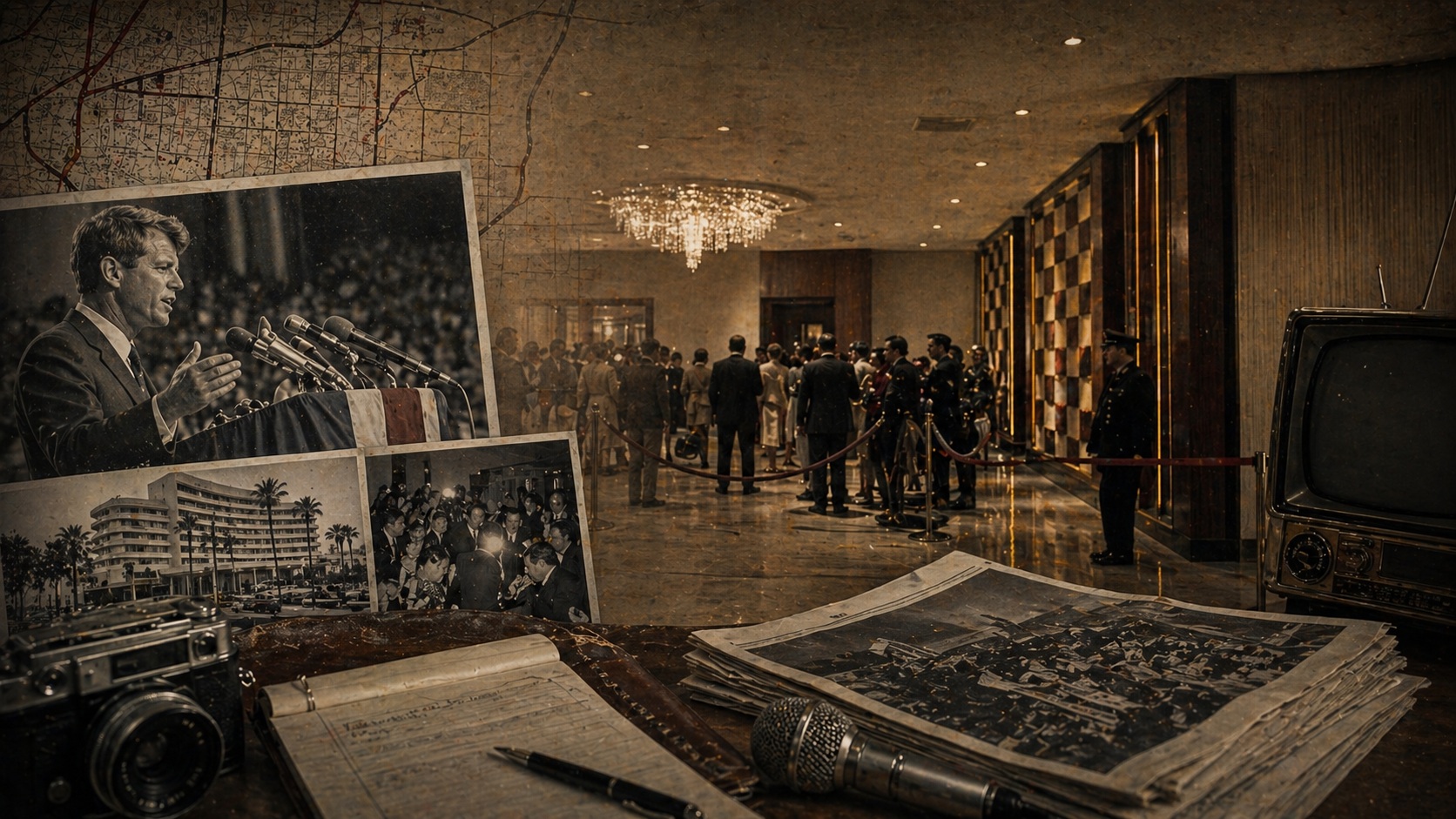
Assassination of Robert F. Kennedy
Robert F. Kennedy was shot after winning the California Democratic primary.
Ask Dr. Whitmore about this eventBackground
At the time, Robert F. Kennedy was listed as candidate. The record is categorized as successful assassination with a high confidence level.
Event details
The reported method was shooting. Successful; Kennedy died on June 6, 1968.
Aftermath
Kennedy died in the early hours of June 6, 1968, at Good Samaritan Hospital in Los Angeles after surgery; the fatal bullet had entered behind his right ear at close range. Sirhan Sirhan was tackled and disarmed at the scene by former Olympic decathlete Rafer Johnson, writer George Plimpton, and NFL player Rosey Grier; five other people in the crowd were also wounded. Sirhan was tried, convicted of first-degree murder in April 1969, and sentenced to death; his sentence was commuted to life imprisonment after the California Supreme Court briefly abolished capital punishment in 1972. He has been denied parole more than a dozen times; California Governor Gavin Newsom rejected a parole board recommendation for his release in 2023. Kennedy's assassination, coming just two months after Martin Luther King Jr.'s murder, deepened the trauma of 1968 and contributed to the passage of the Gun Control Act of 1968.
Historical significance
Robert Kennedy's assassination, occurring just two months after Martin Luther King Jr.'s murder, made 1968 a year of national trauma that defined a generation's disillusionment with American political idealism. Kennedy's death removed a presidential candidate who had explicitly promised to end the Vietnam War, and historians have long speculated that his election would have altered the trajectory of that conflict and the domestic polarization it caused. Congress responded within days by extending Secret Service protection to major presidential candidates—a protection that has been provided ever since. The Gun Control Act of 1968, passed within months, stands as one of the most direct pieces of legislation traceable to a presidential assassination attempt. Sirhan Sirhan's repeated parole denials, sustained for decades by both governors and victims' families, reflect the lasting public anger the killing generated.
Sources
- Assassination of Robert F. Kennedy — Wikipedia contributors
- Gun Control Act of 1968 — Wikipedia contributors
- List of United States presidential assassination attempts and plots — Wikipedia contributors
Related events
Attempted Assassination of Harry S. Truman
Two Puerto Rican nationalists attacked Blair House while Truman was staying there.
Attempted Assassination of John F. Kennedy
Richard Pavlick planned to kill President-elect Kennedy with explosives but did not carry out the attack.
Plot Against John F. Kennedy
A reported Chicago plot against Kennedy shortly before Dallas remains debated but is often included among suspected plots.