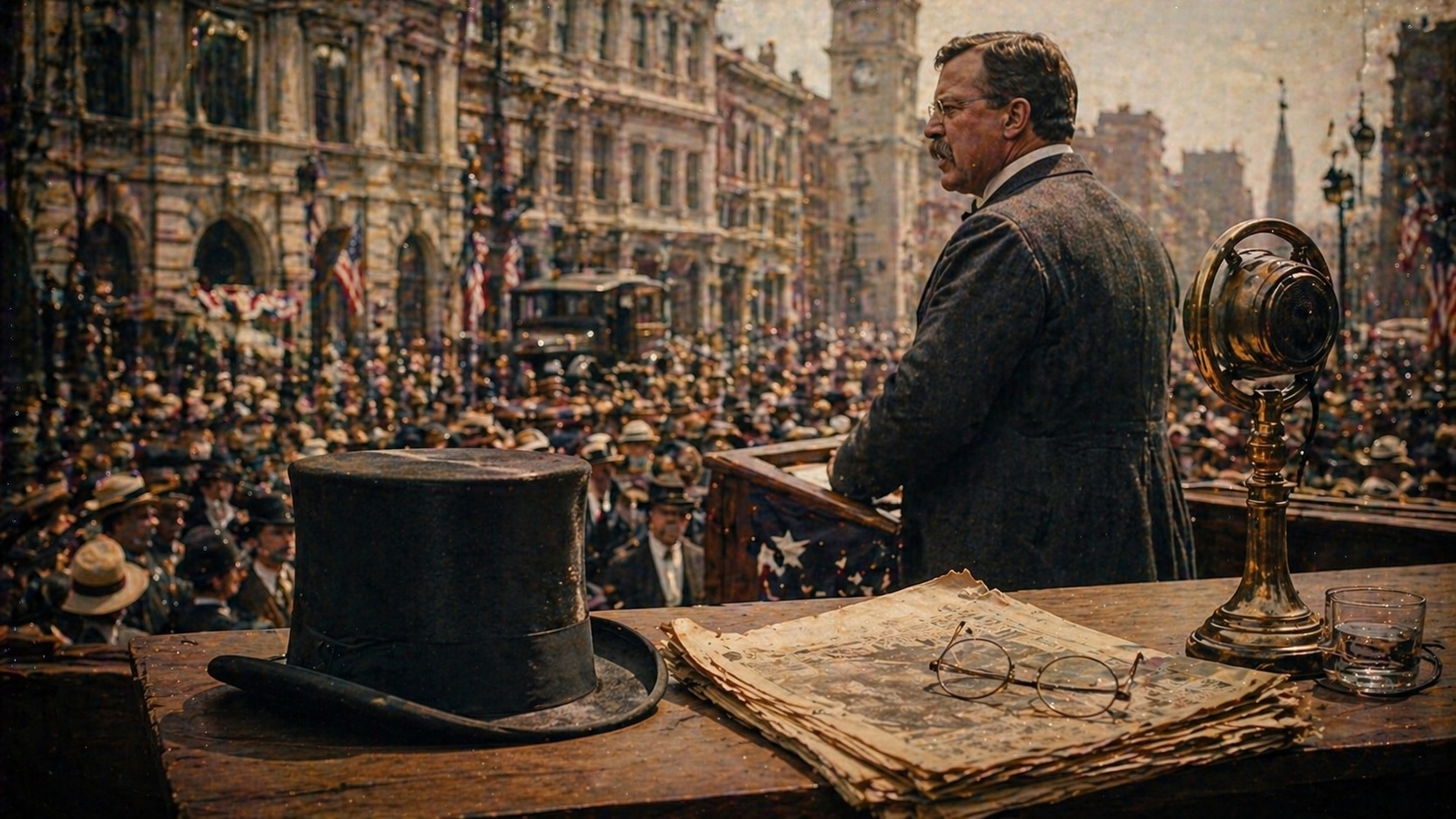
Attempted Assassination of Theodore Roosevelt
Theodore Roosevelt was shot while campaigning as a third-party candidate but survived.
Ask Dr. Whitmore about this eventBackground
At the time, Theodore Roosevelt was listed as former president; candidate. The record is categorized as attempted assassination with a high confidence level.
Event details
The reported method was shooting. Failed; Roosevelt survived and gave his speech.
Aftermath
The bullet, slowed by a steel eyeglass case and a folded copy of Roosevelt's speech in his breast pocket, lodged near a rib and was never removed; Roosevelt carried it for the rest of his life. He delivered the 90-minute address before seeking medical attention, famously telling the audience, 'It takes more than that to kill a Bull Moose.' John Schrank was disarmed and arrested on the spot; he claimed the ghost of William McKinley had appeared to him in a dream and ordered him to prevent any president from serving a third term. Schrank was found insane and committed to the Central State Hospital for the Criminally Insane in Wisconsin, where he died in 1943 without ever standing trial. The incident drew national admiration for Roosevelt's composure and reinforced public debate about the dangers facing political candidates in the Progressive Era.
Historical significance
Roosevelt's decision to deliver his 90-minute speech in Milwaukee after being shot became one of the most celebrated acts of personal fortitude in American political history, burnishing the legend of 'the Bull Moose' and cementing Roosevelt's larger-than-life public image. The attack exposed the complete absence of security provisions for presidential candidates in 1912—a gap not formally addressed until after Robert Kennedy's assassination in 1968. Roosevelt's survival and the dramatic circumstances of the shooting arguably rallied Progressive Party supporters and reinforced the narrative of his invincibility, though Woodrow Wilson won the election when the Republican vote split. John Schrank's fate—committed to an asylum without trial—raised early questions about how American law should handle politically motivated violence by individuals deemed mentally unfit.
Sources
- Attempted assassination of Theodore Roosevelt — Wikipedia contributors
- List of United States presidential assassination attempts and plots — Wikipedia contributors
Related events
Assassination of William McKinley
McKinley was shot at close range by anarchist Leon Czolgosz and died eight days later.
Plot Against William Howard Taft
During Taft's meeting with Mexican President Porfirio Díaz, an armed man was reportedly stopped near the route.
Plot Against William Howard Taft
A reported threat against Taft was relayed to police, but no attacker was identified.